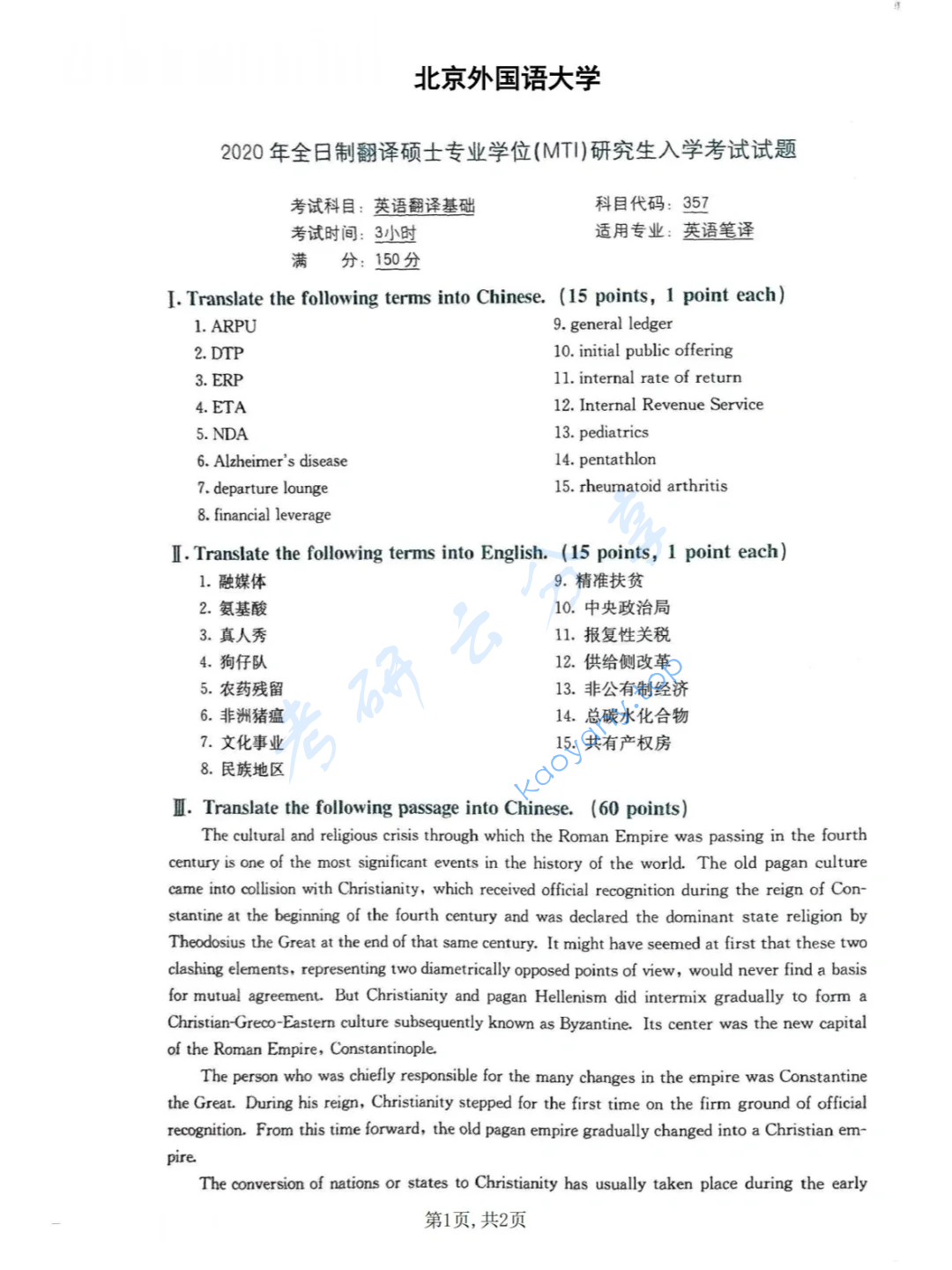
Ⅰ.Translate the following terms into Chinese. (15 points, 1 point each)
1. APRU
2. NDA
3. ETA
4. ERP
5. DTP
6. pediatrics
7. pentathlon
8. Internal Revenue Service
9. initial public offering
10. rheumatoid arthritis
11. Alzheimer’s disease
12. internal rate of return
13. departure lounge
14. general ledger
15. financial leverage
Ⅱ.Translate the following terms into English. (15points, 1point each)
1. 融媒体
2. 氨基酸
3. 真人秀
4. 狗仔队
5. 总碳水化合物
6. 供给侧改革
7. 中共中央政治局
8. 报复性关税
9. 文化事业
10. 精准扶贫
11. 民族地区
12. 非公有制经济
13. 共有产权住房
14. 非洲猪瘟
15. 农药残留
Ⅲ.Translate the following passage into Chinese. (60 points)
The cultural and religious crisis through which the Roman Empire was passing in the fourth century is one of the most significant events in the history of the world. The old pagan culture came into collision with Christianity, which received official recognition during the reign of Constantine at the beginning of the fourth century and was declared the dominant state religion by Theodosius the Great at the end of that same century. It might have seemed at first that these two clashing elements, representing two diametrically opposed points of view, would never find a basis for mutual agreement. But Christianity and pagan Hellenism did intermix gradually to form a Christian-Greco-Eastern culture subsequently known as Byzantine. Its center was the new capital of the Roman Empire, Constantinople.
The person who was chiefly responsible for the many changes in the empire was Constantine the Great. During his reign Christianity stepped for the first time on the firm ground of official recognition. From this time forward the old pagan empire gradually changed into a Christian empire.
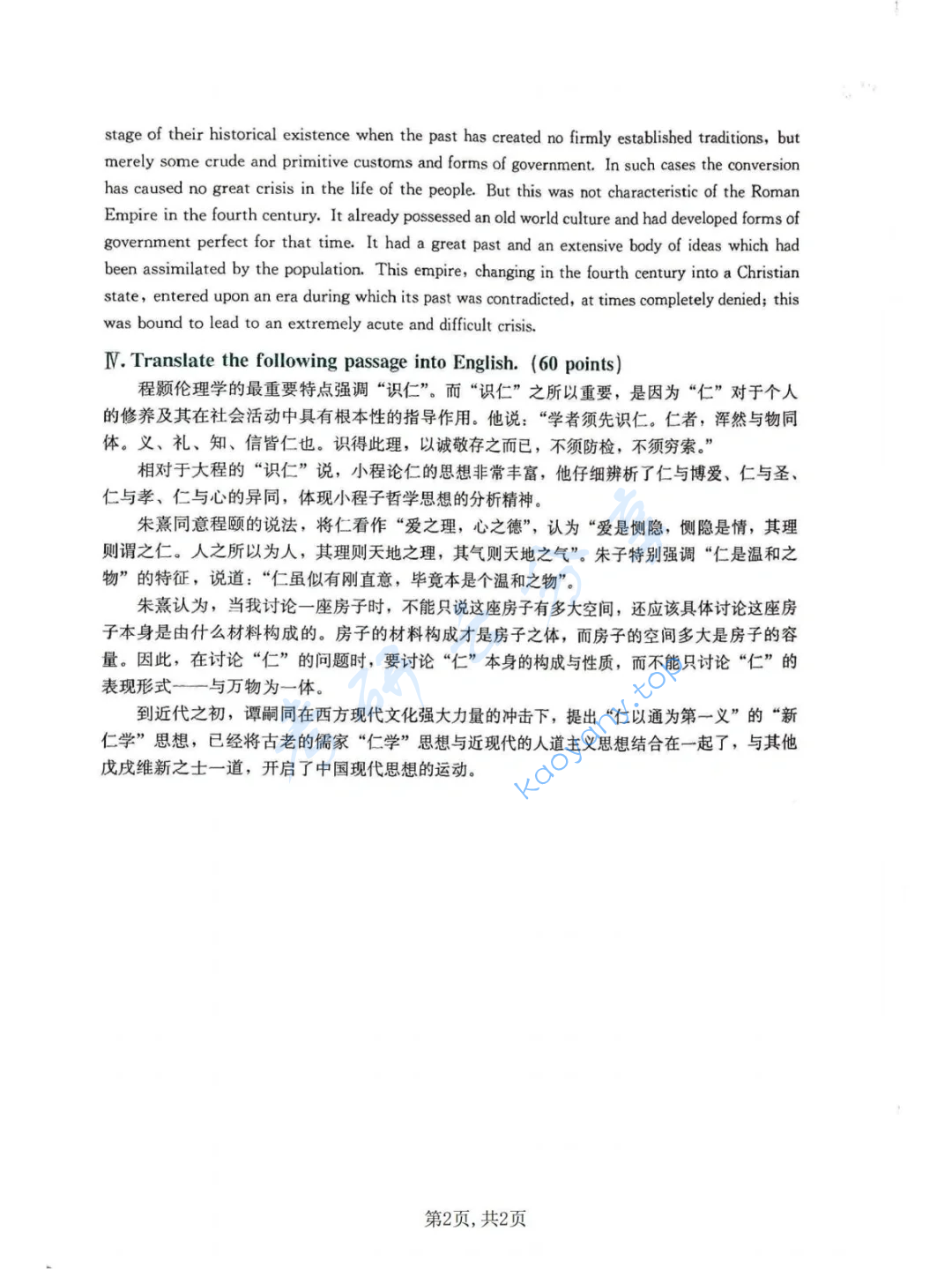
The conversion of nations or states to Christianity has usually taken place during the early stage of their historical existence when the past has created no firmly established traditions, but merely some crude and primitive customs and forms of government. In such cases the conversion has caused no great crisis in the life of the people. But this was not characteristic of the Roman Empire in the fourth century. It already possessed an old world culture and had developed forms of government perfect for that time. It had a great past and an extensive body of ideas which had been assimilated by the population.
This empire, changing in the fourth century into a Christian state, entered upon an era during which its past was contradicted, at times completely denied; this was bound to lead to an extremely acute and difficult crisis.
Ⅳ.Translate the following passage into English. (60 points)
程颢伦理学的最重要特点强调“识仁”。而“识仁”之所以重要,是因为“仁”对于个人的修养及其在社会活动中具有根本性的指导作用。他说:“学者须先识仁。仁者,浑然与物同体。义、礼、知、信皆仁也。识得此理,以诚敬存之而已,不须防检,不须穷索。”
相对于大程的“识仁”说,小程论仁的思想非常丰富,他仔细辨析了仁与博爱,仁与圣人,仁与幸、仁与心的异同,体现了小程子哲学思想的分析精神。
朱熹接受程颐的说法,将仁看作“爱之理,心之德”,认为“爱是恻隐,恻隐是情,其理则谓之仁。人之所以为人,其理则天地之理,其气则天地之气”。朱子特别强调“仁是温和之物”的特征,说道:“仁虽似有刚直意,毕竟本是个温和之物”。
在“求仁”的问题上,朱子不反对致知、格物、博学、审问、慎思、明辨、力行等多种途径。可见,朱子在“求仁”的问题上更看重主体之心的能动性。
朱熹认为,当我讨论一座房子时,不能只说这座房子有多大空间,还应该具体讨论这座房子本身是由什么材料构成的。房子的材料构成才是房子之体,而房子的空间多大是房子的容量。因此,在讨论“仁”的问题时,要讨论“仁”本身的构成与性质,而不能只讨论“仁”的表现形式——与万物为一体。
到近代之初,谭嗣同在西方现代文化强大力量的冲击下,提出“仁以通为第一义”的新仁学思想,已经将古老的儒家“仁学”思想与近现代的人道主义思想结合在一起了,与其他戊戌维新之士一道,开启了中国现代思想的运动。